February 19, 2014 Station Break
No Dire DVD today, folks, so enjoy this armadillo dancing to Michael Jackson’s “Billie Jean” instead.
Tags: video
- Leave a comment
- Posted under Internet
February 18, 2014 Tuesday 10: John Travolta Movies
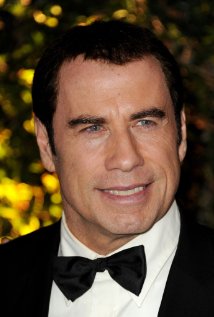
Now say the word “suave” over and over until it loses all meaning (this will take about 3 utterances)
John Travolta turned 60 years old today, so he gets a list. The most surprising thing to me is that there aren’t more movies on the list – not only did I think he had done way more movies, but I also thought I liked a lot more of them. I seriously considered truncating this list after #6, but I put the extra effort in because I like you.
10. Saturday Night Fever (1977) – I’m including this because you’re supposed to. It was a breakout role for Travolta, and he’s great at it, I just don’t happen to enjoy the film that much.
9. Grease (1978) – Some of the songs are fun, but I can’t get past the “remember, girls, the way to get a guy to like you is to change literally everything about you” lesson it blares. I haven’t seen Grease 2 – is it more of the same, just with worse songs?
8. Swordfish (2001) – He plays a bad guy with a soul patch and I think at one point a bus was being carried by a helicopter? I dunno.
7. A Love Song for Bobby Long (2004) – I honestly don’t remember much about this one, but I have it filed under “I liked it okay” so I must have liked it okay.
6. Broken Arrow (1996) – I recently rewatched this one. It’s not great, but it’s fun.
5. The Punisher (2004) – My favorite Punisher movie so far, even though it has terrible elements (Miami? Really?). I really buy Travolta as the sadistic mob boss.
4. Face/Off (1997) – This movie is so full of crazy you can’t help but love it.
3. Phenomenon (1996) – It’s hard to explain why I like this schmaltzfest so much. There’s something about his character doing all of the things he can with the time he has left that is challenging to me, even if I can’t move pens with my mind.
2. Get Shorty (1995) – #4 on my Rene Russo list, #2 here. Chili Palmer is such a fun character that not even the not-good Be Cool follow-up in 2005 can ruin him.
1. Pulp Fiction (1994) – The thing you have to remember is that in 1994, choosing Travolta for this role was seen as a really weird choice by Quentin Tarantino. Now, of course, it’s impossible to imagine anyone else playing Vincent Vega. His dance with Uma Thurman at Jackrabbit Slim’s is one of only, like, 3 dances I’ve ever wanted to learn how to do.
I’m sure “Carrie” should be on this list, and I really wanted to find room for “Battlefield Earth” to be cantankerous, but I couldn’t bring myself to do either one. Sorry to disappoint.
- 2 comments
- Posted under Movies
February 17, 2014 Suddenly Seymour
I have been working on a project all weekend for today but I can’t get it to work the way I want it to, so I’m either giving up on it or working on it more for next Music Monday. I guess we’ll see which I end up doing.
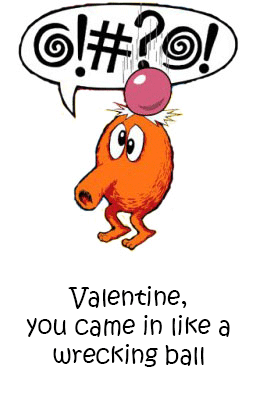
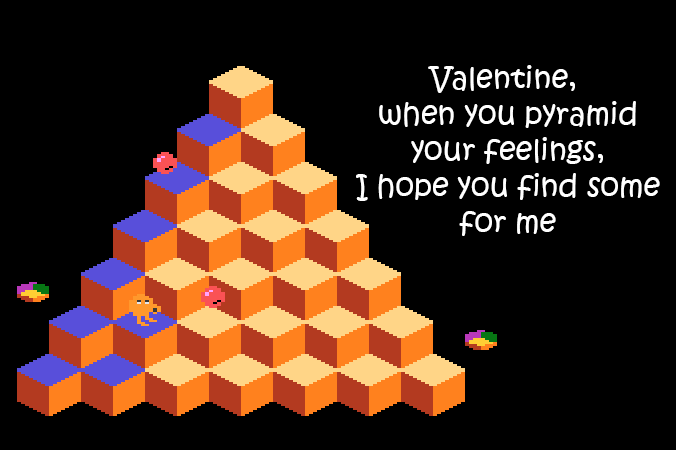
So instead of leaving you with nothing, I’m posting my favorite song from Little Shop of Horrors. I know it’s not everyone’s cup of tea, but hey, apparently neither is Q*bert, so who even knows?
Tags: video
- Leave a comment
- Posted under Music
February 14, 2014 Q*bert Valentines



- 5 comments
- Posted under Videogames
February 13, 2014 Man Of Tai Chi
“Pretty good!”
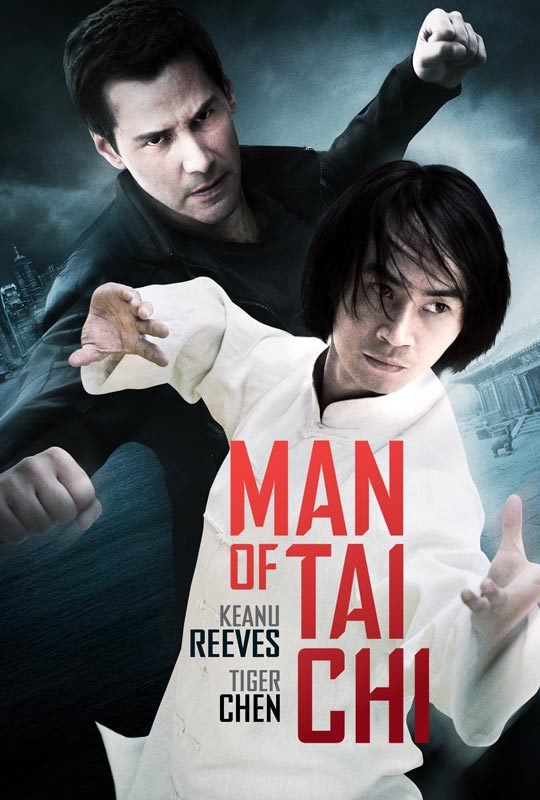
Guy in black vs. guy in white: guess which one’s the hero!
I’ve been sitting here for a while now trying to think of what to say about this movie, and that’s the best I’ve come up with so far. I’m worth every penny this site pays me, folks!
You judge kung fu movies by different standards than you’d judge, say, Shakespearean movies (even if kung fu movies often use Shakespearean themes). Sure, you want a decent story and some good acting, but if those two things are top notch but the fight scenes are lousy, your kung fu movie is lousy. I’m much more forgiving of a movie that has great fight scenes but lousy acting, but only if it’s a kung fu movie. The fight scenes in Titanic weren’t awesome, but it’s still a fine movie, is what I’m saying. You don’t go to see Titanic for its fight scenes. Conversely, if you were to edit out the non-fight scenes of kung fu movies, you’d still be able to appreciate the movie if you were looking to enjoy a kung fu movie. The non-fighting scenes are pretty much there to answer the question “Why are these people fighting?” and some executive producer thought “Because they’re awesome at it!” wasn’t a good enough reason.
Man of Tai Chi introduces us to Tiger Chen, the last student of Tai Chi master Yang. Right from the beginning we see Tiger “has much to learn,” a standard opening for kung fu movies. From there we watch Tiger make choices that seem to be for the right reason, but end up being bad, but then he learns more about what his teacher meant, and then things go better. Again, this is pretty standard for kung fu movies, but “cliché” doesn’t necessarily mean “bad.”
I often feel like kung fu movies are expecting me to bring more knowledge into the viewing than I usually have. While I have learned much about Chinese culture from watching kung fu movies, I don’t have a lot to compare it to, so I don’t know how much of it I can trust. I can, of course, compare what’s presented in one movie to what’s presented in another to get a sense of what’s correct, but I’m sure that I’m missing out on things that would enhance my viewing. For instance, when you watch The Chinese Connection, you pick up pretty quickly on the animosity between the Chinese and Japanese people, but I’m sure with more knowledge of the time period that animosity would be thrown into sharper relief and make the struggle even more meaningful. However, even without that knowledge you can appreciate the student’s desire to avenge his master’s wrongful death.
Many kung fu films are designed to show the strengths of a particular style. One of the threads of this movie is about how people are surprised to see a practitioner of Tai Chi competing and winning. The sense is given that it’s not usually used in this way, so wiki’d myself into some more knowledge on the subject:
The philosophy of t’ai chi ch’uan is that, if one uses hardness to resist violent force, then both sides are certainly to be injured at least to some degree. Such injury, according to t’ai chi ch’uan theory, is a natural consequence of meeting brute force with brute force. Instead, students are taught not to directly fight or resist an incoming force, but to meet it in softness and follow its motion while remaining in physical contact until the incoming force of attack exhausts itself or can be safely redirected, meeting yang with yin. When done correctly, this yin/yang or yang/yin balance in combat, or in a broader philosophical sense, is a primary goal of t’ai chi ch’uan training. Lao Tzu provided the archetype for this in the Tao Te Ching when he wrote, “The soft and the pliable will defeat the hard and strong.”
Traditional schools also emphasize that one is expected to show wude (“martial virtue/heroism”), to protect the defenseless, and show mercy to one’s opponents.
This description of the Tai Chi philosophy really does help my appreciation for the film. Some moments in the film make more sense to me now, and it gives a deeper meaning to the film as a whole. There is a lot of talk about which path Tiger will choose, and at one point he is literally standing on a yin-yang symbol as he studies.
That student/teacher relationship is one of the most powerful in kung fu movies. Very often when a student doesn’t heed his master’s teaching, he comes to a) realize his mistake, or b) a bad end. Much is made of the history of martial arts, and the teacher-student relationship is the way that history continues, so it becomes sacred, in a way. You don’t want to be the last link in a 400-year-old chain. When Tiger realizes what his teacher was trying to get him to understand and uses that knowledge to defeat evil, it’s not surprising, but it’s still cathartic.
This is Keanu Reeves’ directorial debut. You can tell he’s a fan of kung fu movies, as the fights are filmed so you can actually see them. It’s a “this style vs. that style” movie, which is another popular theme in these sorts of films. It’s a theme I’m a complete sucker for, and it’s most likely linked to the same part of my brain that enjoys “Who would win in a fight between Optimus Prime and Voltron?” type questions (answer: Optimus Prime, duh.). There are rough bits here and there, but as I mentioned at the outset, the overall movie was “pretty good!” Keanu plays the villain/catalyst and it’s role I can see him playing more often. He gives off a sinister and calculated vibe, and it’s the first time in a while he’s seemed older to me. I saw 47 Ronin not too long ago and still kind of felt like Keanu was the same age he’d been for a long time. His agedness works well here, and it’s used in his fighting style – he’s more straightforward and brutal, rather than showy and fluid. I hope he makes more kung fu movies, right after Bill & Ted 3 finishes up.
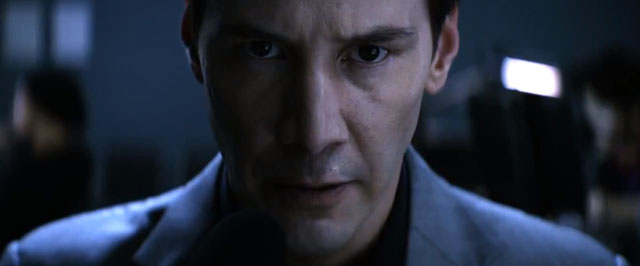
Watch this movie or I will find you and hurt you
Tags: kung fu
- Leave a comment
- Posted under Movies