October 9, 2013 The Weird Al Show

Remember when Weird Al had a Saturday morning show? If you’re a fan of Al and haven’t seen it, you’re missing out. If you’re not a fan of Al, first of all, that’s a strange life decision, and second, this show probably isn’t what you’re after, as it’s pretty much all Al doing Al stuff.
I don’t think it makes much sense to go through this show the same way we went through Better Off Ted. While there’s a plot that the episode sorta hangs on, it’s mostly an opportunity for short spoofs and gags. I think we’ll approach it more from a “this is what happened” angle, which will help those of who who don’t have it handy to watch.
Episode 1: Bad Influence
Aired: September 13, 1997
Guest stars: Barenaked Ladies, Downtown Julie Brown, Patton Oswalt, Kevin Weisman
The Theme Song, which explains the premise of the show pretty well:
Oh, this is a story ’bout a guy named Al
And he lived in a sewer with his hamster pal
But the sanitation workers really didn’t approve
So he packed up his accordion and had to move
To a city in Ohio where he lived in a tree
And he worked in a nasal decongestant factory
And he played on the company bowling team
And every single night he had a strange recurring dream
Where he was wearing lederhosen in a vat of sour cream
But that’s really not important to the storyWell, the very next year he met a dental hygienist
With a spatula tattooed on her arm (on her arm)
But he didn’t keep in touch
And he lost her number
Then he got himself a job on a tater tot farm
And he spent his life-savings on a split-level cave
Twenty miles below the surface of the Earth (of the Earth)
And he really makes a might fine jelly bean and pickle sandwich
For what it’s worthThen one day Al was in the forest trying to get a tan
When he heard the tortured screaming of a funny little man
He was caught in a bear trap and Al set him free
And the guy that he rescued was grateful as could be
And it turns out he’s a big-shot producer on TV
So he gives Al a contract and whaddya know
Now he’s got his very own Weird Al show
Today’s Lesson: Don’t follow people who can get you into trouble. Think for yourself.
Plot summary: Al met a guy named Spike who is “cool” and says he’ll get Al into “the cool club.” Spike visits Al and gets him to do a bunch of things that he says “all the cool guys are doing.” Turns out, Spike’s kind of a jerk, but it takes Al a while to figure it out.
Bits and Pieces:
- Al has two new inventions that we see in this show. Maybe he works for Veridian Dynamics?: X-ray spray and super buoyant edible ping pong balls
- Al mentions playing “43-Man Squamish,” which turns out to have been made up by MAD Magazine.
- Spike wants to use Al’s X-ray spray to see what’s in Christmas presents and learn the combinations for locks
- Harvey the Wonder Hamster shows up, complete with theme song, then he rides a radio control car off a jump and then parachutes to safety. SPike suggests doing it again, but with no parachute and some explosions. (This is not done.)
- “I am so cool!” Al declares after dipping his arms in molten chocolate
- Spike steals Al’s X-ray spray!
- Al makes a sandwich: hickory flavored asphalt with anchovy jello on whole wheat bread – “If you’ve got blacktop and you’ve got gelatin, you’ve got good eatin’!”
- Al’s Eyeball chair for watching TV is perfect and creepy at the same time.
- TV shows: Mr. Rogers’ Neighborhood spoof; Pirate Day Care commercial; Fashion Report (in which Al learns that tearing off his pant leg is no longer cool)
- Pizza Quick commercial: we save time by not putting the pizza in a box.
- Things Spike wants Al to do: tear off his pant leg, dip his hands in molten chocolate, shave off his right eyebrow, wear rabbit ears, get rid of Bobby, break stuff
- Bobby the Inquisitive Boy is aptly named.
- “Accidents are just one of the many Mysteries of the Universe” – Al
- The tips from the “Safety and You” educational film:
-When you’re out in public always check to make sure no spies are following you
-If you find a spider on your shirt, roll, roll on the ground. Spiders are icky.
-And if you lose a pants leg, call home right away so your friends won’t beat you up for looking like a dork.
-Don’t let your parents drive backwards in the rain, it’s just not safe.
-If Dad needs to take a nap, tell him to do it in a bed, that’s what they’re made for.
-And never ever let your dog drive the car - Al’s mailbag is a recurring gag throughout the show’s run
- Seymour (played by Patton Oswalt), Spike’s nerdy-looking friend shows up and dispels all the notions of “cool” and “initiations” and Al finally realizes that Spike is ot a good guy to hang around.
- The Hooded Avenger (Al’s superhero neighbor) has retrieved Al’s X-ray spray!
- And then the Barenaked Ladies show up in Medieval clothes
- Al gets a lot of visitors for living in a cave twenty miles below the surface of the Earth
- BNL sings “Shoe Box”
- The show ends with Al saying “Goodbye! Goodbye! Goodbye goodbye goodbye!”
I don’t know that we’ll go through the whole series, but I wanted to include at least one episode for Weird Al Week. If Al was in a videogame we could cover all of our bases this week, but I don’t think he is.
Tags: Weird Al
- 6 comments
- Posted under TV
October 8, 2013 Tuesday 10: Weird Al Songs
Putting together a Top Ten list of Weird Al songs is a task I’ve put off as long as possible, while still letting it simmer on the back burner. It’s just so daunting, you know? There are so many different ways to do it, too: favorite parodies, favorite originals, funniest, darkest, food-related, TV-related, relationship-related, most listenable – for starters. I decided to give flat-out “favorite” a stab, but please forgive me if I try it again in the future and it comes up differently. In the end, picking favorites ends up being a mix of those things, anyway.
I figured a good starting point would be to see what songs I had on my Zune, figuring if they were zuneworthy, they were obviously some of my favorites. Going through that list of 22 songs revealed two things:
- There are some songs I love that I neglected to put on the Zune. Most notably “Since You’ve Been Gone.”
- Sometimes I put songs from a new album on the Zune for a while but I forget to take them off after the shine is off. Most notably “Perform This Way.”
I thought about calling this my “ten favorite Weird Al songs currently on my Zune,” but that’s fairly unwieldy and kind of ridiculously specific. I think this list ends up being a good representation anyway.
10. Bedrock Anthem – I like this song better than either of the Red Hot Chili Peppers songs it combines. In fact, I am always disappointed when “Under the Bridge” doesn’t segue into “Give It Away” after a little bit.
9. Smells Like Nirvana – This song made me like “Smells Like Teen Spirit,” to date one of very few Nirvana songs I actually like.
8. Amish Paradise – I love when Al parodies rap songs (as you’ll see by this list, apparently!) because it gives me fun subjects to sing along with.
7. Couch Potato – I suspect the original is quite moving because this one makes me want to watch even more TV than I already do.
6. Yoda – The first Weird Al song I ever heard. It was late at night on the Dr. Demento show, turned way down low because I was supposed to be sleeping.
5. White & Nerdy – I’ve talked about this one at length already, but an interesting thing has happened. In my previous breakdown I showed where I didn’t match up. Now, I kind of want to use the song as a template, a list of things to be achieved. I mean, I’ll never manage the science and math stuff, but I sorta want to, and it’s this song’s fault.
4. Eat It – The first song I ever recorded at those “sing to the hits!” booths at amusement parks. I loaned my original copy of my recording to a girlfriend in high school and she (says she) lost it. Thinking about this still kinda knots up my stomach. Lesson: Don’t hand out your originals, people.
3. One More Minute – I sang a slightly-modified version of this for a talent night in college, and it went over pretty well. The good response and the time spent learning it melded an already-great song to my favorites list.
2. It’s All About the Pentiums – I’d love to see Al update this one every couple of years to reflect new trends. The video for this one might be my favorite of his.
1. The Biggest Ball of Twine in Minnesota – I can’t rightly explain why this one is my favorite. It’s partly the story-telling, it’s partly the list of real places, it’s partly the characters in it, it’s partly the tune. No one I’ve ever made listen to it (under the banner of “You have to hear this!”) has ever liked it as much as me, but I still have a dream of performing it some day. I don’t really know what that particular performance and crowd would like like, but it’s still on my dreams list.
- 2 comments
- Posted under Music
October 7, 2013 Albuquerque
These days when you mention Albuquerque, New Mexico, most folk’ll immediately think about Breaking Bad. It makes sense: the show was filmed in and around the city, and uses many local landmarks in the show.
I haven’t seen Breaking Bad, though. And even when I eventually do, Albuquerque will still trigger for Weird Al first. I’ve already talked about this song before, but today it gets a special mention because I am actually in Albuquerque while I am writing this article. Not only that, I am listening to the song “Albuquerque” while writing an article about Albuquerque while I am in Albuquerque. Is your mind blown? Because mine is.
Oh, you’ve never heard the song? Or it’s been too long? Give this video a try. It isn’t “official,” but it is a fun Flash animation video of the song:
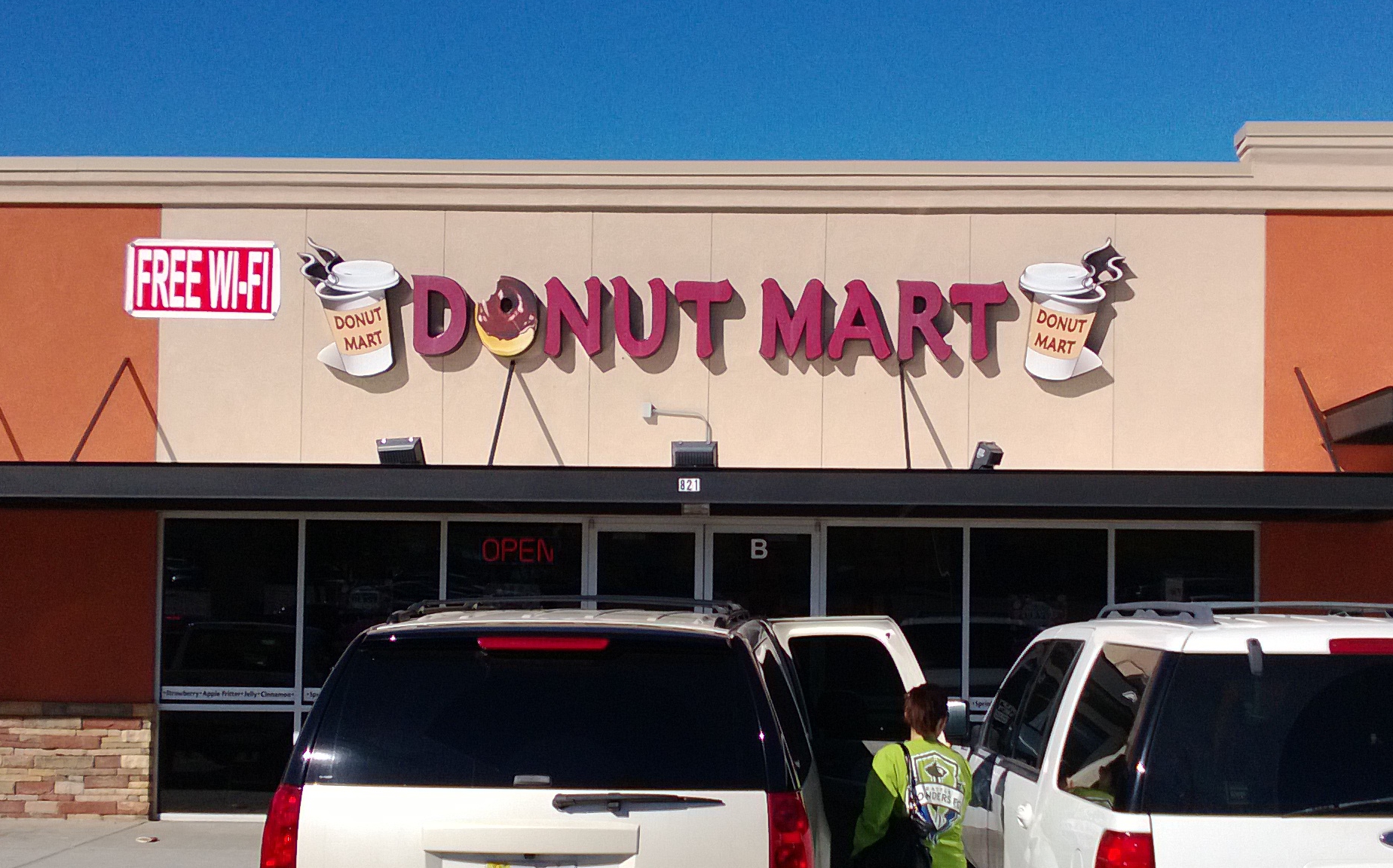
Who needs a Donut Mart? I doooooooooooooo
Luckily, any donuts I wanted they had, so I didn’t have to settle for a box of starving crazed weasels.
I did see the/a “world famous Holiday Inn,” but I wasn’t able to get a picture of it. Maybe next time.
October 7, 2013 Weird Al Week
It’s Weird Al Week! Why? Circumstances!
On Wednesday, I’m going to a 25th Anniversary screening of UHF, hosted by Weird Al himself. Two days later I’m going to see Weird Al in concert for the third time.
Those two circumstances made me feel like it was Weird Al Week already, so it might as well be Weird Al Week here, too. Every article this week will have something to do with Weird Al, and that’s what Weird Al Week is all about.
Welcome aboard!
- Leave a comment
- Posted under Music, Site
October 4, 2013 Fact or Film Fiction: Into the Wild
Fact or Film Fiction is a new series by Meags that looks at films claiming to be about true events and seeing how they stack up to said events. Whether the film is good or bad is ancillary to the discussion (it might be mentioned, but it’s not the focus).
My Verdict: Wildly melodramatic.
When starting this new series, I assumed that Into the Wild would be an easy one to start with. The film, about the life and death of Christopher J. McCandless, is based on a best-selling book by Jon Krakauer. So, I set out to read that book, then watch the movie again and write up where the movie changed things up, and voila. I anticipated a few shortcuts here, a few fake conversations there. But then, I did a Google search, which led me down several rabbit holes I did not expect to go down. What I discovered was that the movie doesn’t stand up to scrutiny, but neither does the book.
For those of you who did not spend the 2 1/2 hours to watch the Sean Penn written and directed film, here’s the story: A troubled young man cuts himself off from his family and most of the people he knows to wander around the USA (first by car, but later on foot) to live off the land, while obtaining random jobs to supplement his foraging and the mercy of strangers. In the summer of 1992, he went into Alaska, off the Stampede Trail, and lived in an abandoned bus for a little over 100 days, where he starved to death. He was found by some moose hunters approximately 2 weeks after his death.
The film itself is beautiful and hypnotic. The Alaskan backgrounds are breathtaking in their scope, and the film artfully recreates a state of mind of adventure and confusion, while telling the story of this young man. There are a few details that are completely fabricated. For example, Chris worked at a McDonald’s during his journey, not a Burger King. He took a canoe down the Colorado River, not a kayak. But in the big picture, this are silly nitpicks. So I’m going to focus on a few major themes.
What the film got right: the strain in the McCandless family
One thing that the book de-emphasized and the film did not was the tensions between the McCandlesses, particularly between Chris and his father, Walt McCandless. Both works were aided and influenced by Chris’ surviving family members, and this lends a certain bias to it, as Chris can’t explain himself from the grave. The film clearly depicts a dysfunctional family, one governed by fear and stress, particularly in one scene where Carine, played by Jena Malone, has a voice-over while screaming and fighting takes place in the background. This is only speculation, but I believe that Krakauer was unable to put into words what Carine McCandless had shared out of fear of an accusation or limited cooperation from Chris’ parents. By showing this scene in the film as a background to a vaguely related voice-over, Penn could show this part of the story without actually making an accusation. On a fan site dedicated to Chris McCandless, Carine provided a letter which clearly describes how their childhood was deeply traumatic to her and her brother as they grew up. She writes:
We indeed had the privilege of family vacations. Yet aside from smiling children frozen in time through family photos, I am disturbed by their quote “All of this was driven by a desire to make sure that all felt as one and that hopefully they would continue that fellowship through the rest of their lives.” In reality they often made attempts to pit us against each other in an effort to prevent unity and communication. Yet they now take credit for the close relationship we siblings maintain to this day. We are our family. It is a fact that Walt and Billie consistently refuse to talk honestly about the past whenever their children reach out to them for healing and closure. We are still blamed for their poor choices.(1)
The tensions between Chris and his father stemmed from learning that his father had been living a double life, that the relationship between his parents had been adulterous, and his father continued to maintain a relationship with his first wife even after Chris had been born. Some writers have wondered why Chris was so harsh on his father while allowing moral leniency to others, including Wayne Westerberg, who was arrested for making “black boxes” (a device that obtains satellite programming for free) during their acquaintance. Chris’ writings are peppered with ideas about truth and morality, so we know these are thoughts he was consumed with, but there are no easy answers to why he reacted so strongly to his father’s sins and disregarded those of others.
The poison plant death theory has been disproven over and over
The medical examiner ruled Chris’ death as caused by starvation. His body had no subcutaneous fat on it, and it was estimated that his BMI had dipped under 14, which is the lowest a human body can continue to function at. At the time of his autopsy, his body only weighed 67 lbs. However, in the film (and somewhat in the book, more on that later), Penn shows Chris’ death as occurring due to a mix-up of two different plant species, wild potato root (H. alpinum) and wild sweet pea (H. mackenziei). There a number of reasons this is unlikely, and Krakauer himself agrees. The largest reason this is unlikely is because neither of these plants are poisonous. The film goes the extra mile to bolster this fiction. As foraging specialist Samuel Thayer writes:
…the film’s most egregious deception occurs when [Emile Hirsch as] Chris opens up Tanaina Plantlore (Kari, 1987). The book’s actual cover is shown, but when Chris flips to page 128 to read about H. mackenziei, the movie shows a counterfeit page that the producers have forged and inserted. The excerpt from the book that McCandless reads in the film goes like this (Yes, it really does go like this; the apparent errors and omissions are original.):
The lateral veins, nearly invisible on leaflets of wild sweet pea the plants poisonous seedlings. If ingested symptoms include partial motor paralysis, inhibition of digestion, and nausea. If untreated leads to starvation and death. Another way to distinguish is that the stem of the wild sweet pea is mostly unbranched.
That’s strange, because when I open to page 128 in my copy, it only says this in the same place:
The lateral veins of the leaflets of wild sweet pea are hidden, while those of the wild potato are conspicuous. Another way to distinguish between the two plants is that the stem of the wild sweet pea is mostly unbranched, while that of the wild potato is definitely branched.”(2)
Krakauer, for his part, has had difficulty letting go of the idea that something caused Chris to deteriorate quickly and prevent him from trying to cross the Teklanika River and return to civilization. He first posited the mistaken identity hypothesis in the original Outside Magazine article he wrote on Chris in 1993. By the time he wrote the full length book, Into the Wild, in 1996, he had changed his theory to one that described the difference between the roots of the wild potato plant and the seeds, which he believed was the true culprit. Perhaps the seeds had a mold on them that produced a specific alkaloid known to be toxic to farm animals. Krakauer had several specimens of both types of plant send to a lab for testing. After the book was published, however, the lab researcher, Dr. Thomas Clausen, admitted that he couldn’t find anything poisonous about the plants, and that he would “eat it myself”. (3)
Fast forward to September 2013, and the story has changed once again. In an article in the New Yorker magazine, Krakauer shared a theory from Ronald Hamilton, that the cause of death may have been ODAP poisoning from a protein in the wild potato root seed. This protein was found in the samples that Krakauer sent to a lab. I’m not rejecting the theory out of hand, but it seems like the much simpler explanation is that Chris was running a severe caloric deficit in his 113 days in Alaska, surviving on small game and limited foraging, and unfortunately starved to death. However, the starvation hypothesis runs contrary to the mythos of Chris McCandless, and what many of his “fans”, for lack of a better word, want to posthumously recreate him as. Which leads us to the final theme.
Speculating what was going through Chris’ mind is only that: speculation
A lot of scenes in the film are fictional, merely for the reason that those events are unknowable. Chris did keep some photo journals and wrote his thoughts down periodically throughout his adventure, but some things had to be made up in order to keep the story flowing. A lot of those things include his thoughts and emotions throughout, and also what his motivations were. Most of this we can never really know, since Chris is not here to tell us. The film manipulates the viewer into seeing the events a certain way, by what is omitted from the film, along with what is there. Chris had not only identification and cash in his possessions when he died, but he also had a map. This map was released to the family with some other belongings after his autopsy was completed, and it is unclear what it was a map of. While he was evidently unprepared for Alaska during the time he was there, the theory that he wanted to completely cut himself off from civilization permanently is somewhat romanticized. Both Penn and Krakauer imply that the reason that Chris decided to leave the bus in July was due to the following passage in Leo Tolstoy’s “Family Happiness”:
I have lived through much, and now I think I have found what is needed for happiness. A quiet secluded life in the country, with the possibility of being useful to people to whom it is easy to do good, and who are not accustomed to have it done to them; then work which one hopes may be of some use; then rest, nature, books, music, love for one’s neighbor—such is my idea of happiness. And then, on top of all that, you for a mate, and children perhaps—what can more the heart of man desire?
However, a simpler explanation could be that he realized that the game and plant life in the area he had settled in was insufficient to meet his dietary needs, and he needed to return to the city, regain health, before trying another adventure. Ideas like this only serve to mythologize a man who died unnecessarily.
Another example is how Chris came to leave the yellow Datsun behind. Chris parked his car in an area that was known to have flash flooding, and where cars were not permitted. (This part is shown in the film.) However, not only did Chris not spend the night in the Datsun (he slept in a tent), but he was incredibly frustrated when he tried to start the vehicle and realized the engine was flooded. He had not intended to abandon the vehicle but saw no other option, since asking for help to move an illegally parked vehicle was out of the question. While subtle, the film gives the viewer the impression that Chris wanted to completely remove himself from modern life, ditching his car was another way to prevent his family from tracing him. The true story tends to make Chris seem more impulsive, and is demonstrative of his poor planning skills.
———————-
In the end, there are a lot of unanswered questions about Chris’ state of mind and about the minutiae of his last two years. Both the film and the book show a Chris of the author or filmmaker’s design. His story has been adopted by many who consider him to be a visionary. There’s yet another theory about what caused the demise of Chris McCandless, propagated by Craig Medred, one of the original writers on the story for the Anchorage Daily News, and that is that Chris was suffering from the onset of schizophrenia.(4) I feel that it is about as likely as the idea that poisonous seeds did him in. Considering that hundreds of people flock to that old bus and have made it into a shrine, or want to replicate his journey, or consider him a hero against the trapping of a modern life, I find it difficult to believe that all or most of those people are also suffering from mental illness. The most likely scenario is that a young man without experience or perspective thought “how hard can it be?” and embarked on a journey that, unfortunately, turned fatal.
Bonus features: includes complete list of sources and other trivia about the film
1. http://www.christophermccandless.info/carinemccandless.html
2. http://foragersharvest.com/into-the-wild-and-other-poisonous-plant-fables/
3. http://www.mensjournal.com/magazine/the-cult-of-chris-mccandless-20121015
4. http://www.farnorthscience.com/2007/10/13/media-watch/into-the-wild-the-false-being-within/
Tags: FFF
- 6 comments
- Posted under Movies